BMI Calculator: Formula, Categories & Limitations Explained + Free Tool
Learn the BMI formula for metric and imperial units, the WHO weight categories, and the well-documented limitations of BMI as a health screening measure — free, instant calculator.
ToolNest AI Team
Author
Published
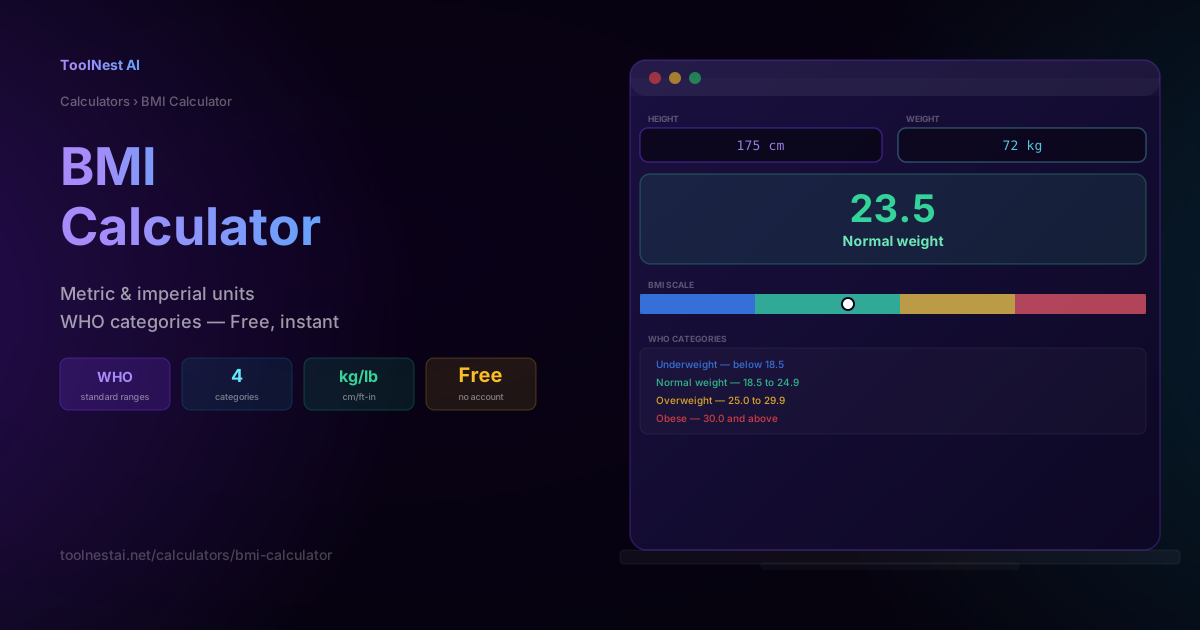
Body Mass Index shows up on nearly every medical intake form, fitness app, and health article — but few people know it was invented in the 1830s as a population statistics tool, not a clinical diagnostic instrument. Understanding what BMI actually measures, and just as importantly what it doesn't, helps you interpret your number correctly rather than over- or under-weighting what it means.
This guide covers the exact BMI formula for both metric and imperial units, the WHO's standard weight categories, and BMI's well-documented limitations. Calculate yours instantly with the ToolNest AI BMI Calculator.
What Is BMI?
Body Mass Index (BMI) is a simple numeric measure derived from a person's height and weight, used as a population-level screening tool to categorize weight status. It was devised in the 1830s by Belgian mathematician and statistician Adolphe Quetelet — originally called the "Quetelet Index" — as part of his broader work on "social physics," applying statistical methods to human populations. It was never intended as an individual diagnostic tool.
The World Health Organization adopted standardized BMI category thresholds in the 1990s, and BMI has since become the most widely used weight-screening measure in clinical and public health settings worldwide, largely because it requires only a scale and a tape measure — no specialized equipment.
The BMI Formula — Metric and Imperial
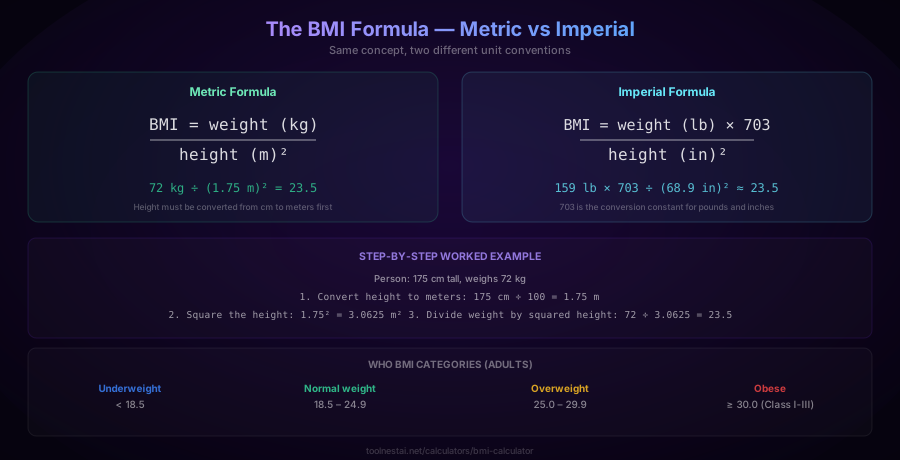
Metric formula:
BMI = weight (kg) ÷ height (m)²
Imperial formula:
BMI = (weight (lb) × 703) ÷ height (in)²
The 703 constant in the imperial formula exists purely to convert pounds and inches into an equivalent kg/m² result, since the underlying concept (mass divided by height squared) is unit-dependent.
Worked example (metric): a person who is 175 cm tall and weighs 72 kg.
- Convert height to meters: 175 cm ÷ 100 = 1.75 m
- Square the height: 1.75² = 3.0625 m²
- Divide weight by squared height: 72 ÷ 3.0625 = 23.5
Worked example (imperial): a person who is 5'9" (69 inches) and weighs 159 lb.
- BMI = (159 × 703) ÷ 69² = 111,777 ÷ 4,761 ≈ 23.5
Both examples describe roughly the same body, which is why they converge on the same BMI value — the formula is unit-agnostic in what it measures, only the arithmetic changes.
WHO BMI Categories
| Category | BMI Range |
|---|---|
| Underweight | Below 18.5 |
| Normal weight | 18.5 – 24.9 |
| Overweight | 25.0 – 29.9 |
| Obese (Class I–III) | 30.0 and above |
These ranges apply to adults and are the standard reference used by the WHO and most national health agencies. The obese category is sometimes further subdivided: Class I (30.0–34.9), Class II (35.0–39.9), and Class III (40.0+, sometimes called "severe" or "morbid" obesity), reflecting increasing associated health risk.
Important: these adult thresholds do not apply to children and teenagers. Pediatric BMI is instead expressed as an age- and sex-specific percentile compared against population growth charts, since body composition changes substantially and non-linearly during childhood development.
Why BMI Isn't the Whole Picture
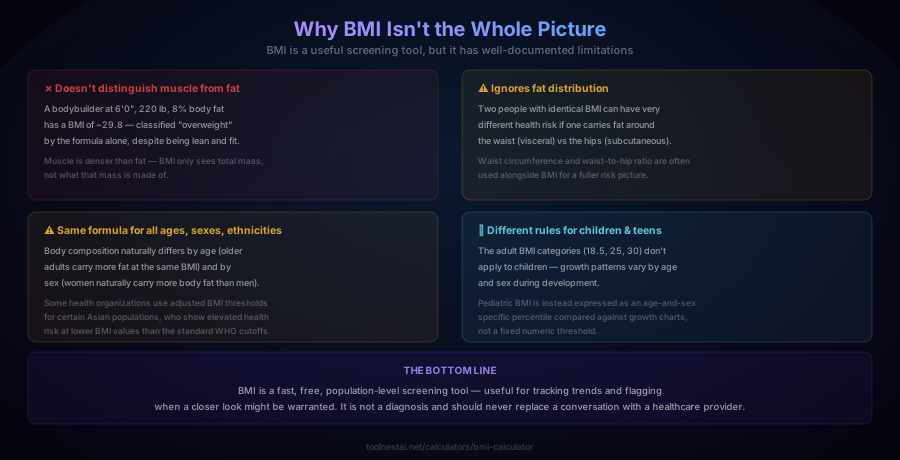
BMI is a useful, fast, free screening measure — but it has well-documented limitations that matter for interpreting an individual result correctly.
It doesn't distinguish muscle mass from fat mass. Muscle tissue is denser than fat tissue, so a muscular, lean individual can have a high BMI purely from muscle weight. A bodybuilder at 6'0" and 220 lb with 8% body fat has a BMI of roughly 29.8 — classified "overweight" by the number alone, despite being lean and highly fit. BMI cannot see body composition, only total mass relative to height.
It ignores where fat is distributed. Two people with an identical BMI can have very different health risk profiles depending on whether their fat is concentrated around the abdomen (visceral fat, associated with higher cardiovascular and metabolic risk) versus the hips and thighs (subcutaneous fat, generally lower risk). Waist circumference and waist-to-hip ratio are frequently used alongside BMI to get a fuller picture.
It applies the same formula regardless of age, sex, or ethnicity. Body composition naturally shifts with age — older adults tend to carry more body fat at the same BMI as younger adults. Women, on average, naturally carry a higher body fat percentage than men at equivalent BMI values. Additionally, some health organizations use adjusted BMI action thresholds for certain Asian populations, who have been shown in research to face elevated metabolic health risk at BMI values below the standard WHO cutoffs.
It isn't valid for children. As noted above, pediatric BMI interpretation requires age- and sex-specific growth chart percentiles rather than the fixed adult thresholds.
The bottom line: BMI is a fast, free, population-level screening tool — genuinely useful for tracking trends over time and flagging when a closer conversation with a healthcare provider might be worthwhile. It is not a diagnosis, and it should never replace individualized medical assessment.
How to Use the BMI Calculator
The ToolNest AI BMI Calculator runs entirely in your browser and supports both unit systems.
- Choose your unit system — metric (centimeters and kilograms) or imperial (feet/inches and pounds)
- Enter your height and weight
- View your BMI value and WHO category instantly, with a visual scale showing where you fall
- Check your healthy weight range — the tool calculates the specific weight range (in your chosen units) that corresponds to a "normal weight" BMI at your exact height
BMI Calculations in Different Languages
JavaScript:
function calculateBMI(weightKg, heightCm) {
  const heightM = heightCm / 100;
  return weightKg / (heightM * heightM);
}
calculateBMI(72, 175); // 23.51...
Python:
def calculate_bmi(weight_kg, height_cm):
    height_m = height_cm / 100
    return weight_kg / (height_m ** 2)

calculate_bmi(72, 175)  # 23.51...
Imperial (JavaScript):
function calculateBMIImperial(weightLb, heightIn) {
  return (weightLb * 703) / (heightIn * heightIn);
}
calculateBMIImperial(159, 69); // 23.48...
Common Mistakes
Mistake 1: Forgetting to convert height units before squaring. The metric formula requires height in meters, not centimeters — using centimeters directly without dividing by 100 produces a wildly incorrect (extremely low) BMI value.
Mistake 2: Treating BMI as a diagnosis rather than a screening measure. A single BMI reading, in isolation, cannot determine an individual's health status. It should be considered alongside other factors — body composition, waist circumference, blood pressure, activity level, and overall medical history.
Mistake 3: Applying adult BMI categories to a child. As covered above, children require age- and sex-specific percentile charts, not the fixed 18.5/25/30 thresholds used for adults.
Mistake 4: Ignoring the muscle-mass caveat for athletes. Highly muscular individuals frequently fall into "overweight" or even "obese" BMI categories despite having low body fat percentages and excellent cardiovascular fitness — BMI alone will misclassify these cases.
Mistake 5: Using outdated or incorrect category thresholds. Some sources still use pre-1998 U.S. National Institutes of Health thresholds that differ slightly from the now-standard WHO ranges. Always confirm which reference standard a given tool or chart is using.
Frequently Asked Questions
What is a healthy BMI range?
According to WHO standards, a "normal weight" BMI for adults falls between 18.5 and 24.9. Below 18.5 is classified underweight, 25.0–29.9 is overweight, and 30.0 and above is obese. These ranges apply to adults; children and teenagers require age- and sex-specific percentile-based interpretation instead.
How do I calculate my BMI manually?
In metric units: divide your weight in kilograms by your height in meters squared (BMI = kg ÷ m²). In imperial units: multiply your weight in pounds by 703, then divide by your height in inches squared (BMI = (lb × 703) ÷ in²). For example, a 175 cm, 72 kg person has a BMI of 72 ÷ 1.75² = 23.5.
Is BMI accurate for athletes and bodybuilders?
Not reliably. BMI only measures total mass relative to height — it cannot distinguish muscle mass from fat mass. Since muscle is denser than fat, athletes and bodybuilders with significant muscle mass are frequently classified as "overweight" or "obese" by BMI alone, despite having low body fat percentages and strong cardiovascular health. Body fat percentage measurement (via calipers, DEXA scan, or bioelectrical impedance) gives a more accurate picture for muscular individuals.
Does BMI apply the same way to men and women?
The BMI formula itself is identical regardless of sex, but interpretation should account for the fact that women naturally carry a higher average body fat percentage than men at the same BMI value. Some researchers argue sex-specific BMI thresholds would be more accurate, though the WHO's standard categories currently apply uniformly.
Can children use the same BMI categories as adults?
No. The fixed adult thresholds (18.5, 25.0, 30.0) do not apply to children and teenagers, whose body composition changes substantially and non-linearly during growth. Pediatric BMI is instead expressed as a percentile relative to age- and sex-matched growth charts (for example, the CDC growth charts), not as a fixed numeric cutoff.
Why did my BMI change even though I didn't gain or lose weight?
If your BMI calculation changed without any actual weight or height change, check for a unit or input error — for example, entering height in centimeters when the calculator expects meters, or accidentally swapping height and weight fields. If both inputs are correct and unchanged, the calculated BMI should be identical.
Is BMI the best way to measure health?
No single measure captures overall health, and BMI is a limited, population-level screening tool rather than a comprehensive health assessment. It doesn't account for body composition, fat distribution, cardiovascular fitness, or many other relevant health factors. Many health professionals now recommend using BMI alongside additional measures — like waist circumference, body fat percentage, and blood work — for a more complete picture. Always consult a healthcare provider for a full individual assessment rather than relying on BMI alone.
What's the healthy weight range for my specific height?
The ToolNest AI BMI Calculator computes this directly — after entering your height, it shows the exact weight range (in your chosen units) that corresponds to a BMI between 18.5 and 24.9 for that specific height. For example, someone 175 cm tall has a "normal weight" range of approximately 56.7 kg to 76.3 kg.
About the author
ToolNest AI Team
The ToolNest AI team builds free tools that help developers, marketers, and creators do more online — faster.
Related Articles
Age Calculator: Calculate Exact Age & Date Differences Free Online
Learn how age is actually calculated, the leap year rule and how it affects February 29 birthdays, calendar vs full-day calculation methods, and practical uses beyond birthdays — free, instant tool.

Word Counter: Count Words, Characters & Reading Time Free
Learn how to use a word counter to track words, characters, sentences, paragraphs and reading time — plus a complete reference of character limits for every major platform.