AI Detector: How to Detect AI-Generated Content Accurately (2026 Guide)
Learn how to use a free AI detector to identify AI-generated content from ChatGPT, GPT-4, Claude, Gemini and more. Step-by-step guide, comparison table, accuracy explained, and 8 expert FAQs.
ToolNest AI Team
Author
Published
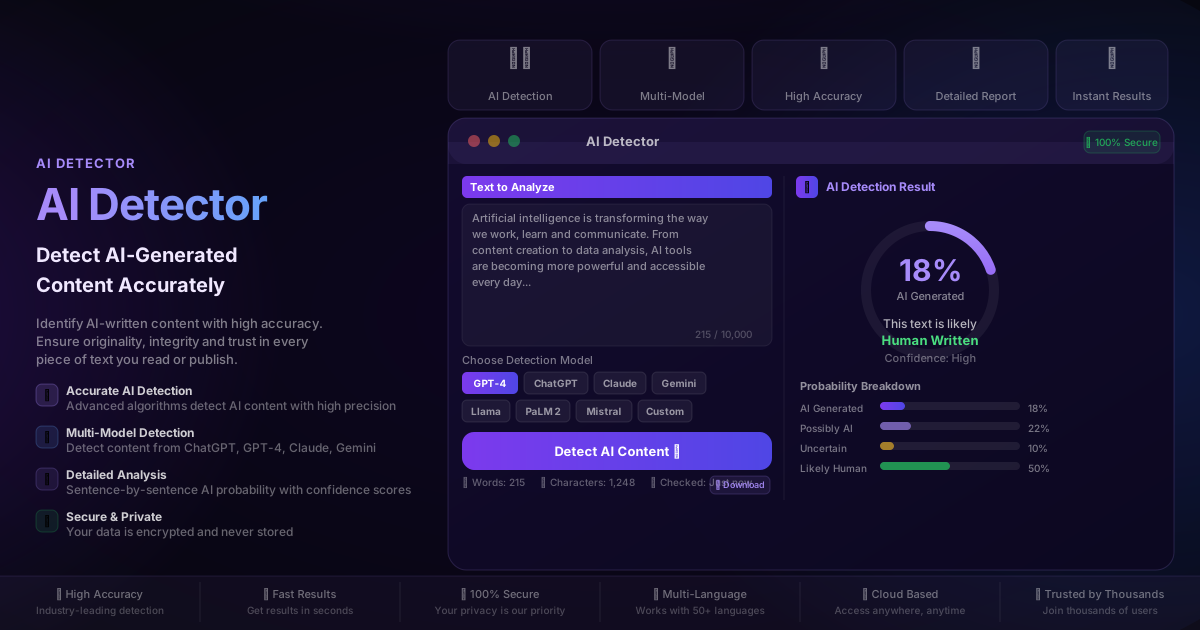
Content integrity matters more than it did two years ago. AI writing tools have become fast, capable, and widely used — which means the question "did a human write this?" is now asked in classrooms, newsrooms, hiring pipelines, and content teams every day.
The challenge is that AI-generated text looks convincing. It is grammatically correct, well-structured, and often indistinguishable from human writing at a glance. Spotting it reliably requires analysis that goes deeper than reading — it requires understanding the statistical patterns that large language models leave behind.
That is what an AI detector does. This guide explains how to use one effectively, what the results mean, and where detection has real limits you should know about.
Table of Contents
- What Is an AI Detector?
- How AI Detection Works
- Step-by-Step: How to Use the AI Detector
- Best AI Detectors Compared (2026)
- Detection Accuracy and Limitations
- Pros and Cons of AI Detection Tools
- Who Uses AI Detectors?
- Common Mistakes When Using AI Detectors
- Frequently Asked Questions
What Is an AI Detector?
An AI detector is a tool that analyses text and estimates the probability that it was generated by an AI model rather than written by a human. It does not read the text the way a human editor would — it runs statistical analysis on patterns in sentence structure, vocabulary distribution, and the predictability of word choices.
The underlying idea is that AI-generated text and human-written text have different statistical fingerprints. Human writing contains more variation: unpredictable word choices, irregular sentence lengths, personal anecdotes, and moments of genuine surprise. AI writing tends toward lower perplexity — its word choices are more predictable because the model always selects statistically likely continuations.
An AI detector quantifies this difference and returns a probability score: how likely is it that this text came from a model rather than a person?
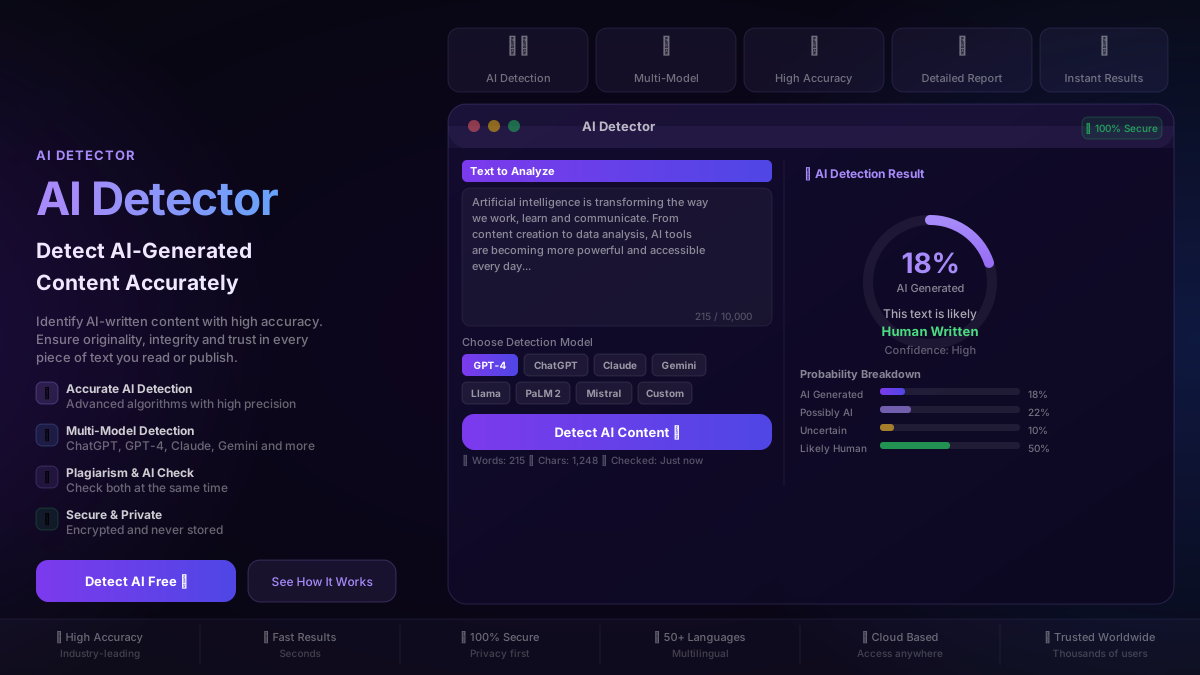
Modern detectors go further than a single score. The best tools — including the ToolNest AI Detector — identify which specific models the content is most likely to have come from, provide sentence-level highlighting to show which sections triggered the AI flag, and show a full probability breakdown across multiple categories.
The result is not a verdict. It is evidence — one strong signal among several that you should use when assessing content authenticity.
How AI Detection Works
AI detection is built on three core concepts that are worth understanding before you interpret results.
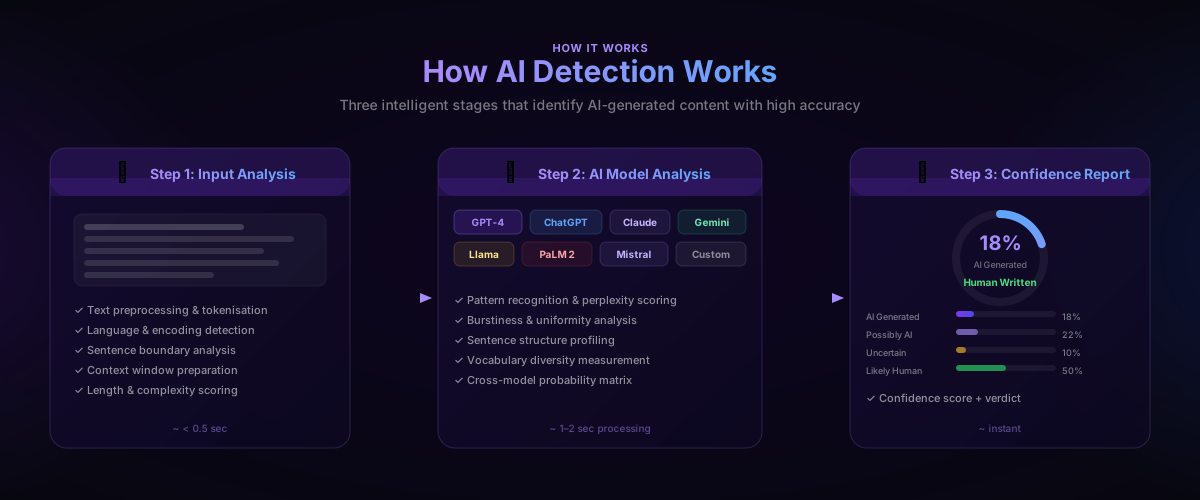
Perplexity. This measures how surprising each word choice is given the words before it. High perplexity means the text is unpredictable — the kind of variance a human writer naturally introduces. Low perplexity means each word follows logically and predictably from the last. AI models are trained to predict likely next tokens, which is precisely why their output tends toward low perplexity.
Burstiness. Human writing is not evenly distributed. It has bursts: some paragraphs are dense and complex, others are short and punchy. AI text tends toward uniform sentence complexity — consistently moderate, rarely bursting into very short or very long sentences. Low burstiness is a common marker of AI output.
Cross-model pattern matching. Different AI models have distinct stylistic signatures. GPT-4 and ChatGPT have particular tendencies in how they structure arguments and use transition phrases. Claude has different phrasing habits. A well-built detector maintains pattern profiles for multiple models and scores incoming text against all of them simultaneously.
Vocabulary distribution analysis. AI models favour certain vocabulary ranges. They tend to avoid very rare words and avoid very common filler words in predictable ratios. Human writers are messier — they overuse pet phrases, under-use words they do not know well, and sometimes use highly technical vocabulary alongside plain language in ways models rarely replicate.
The combination of these signals — not any one of them alone — is what gives modern AI detectors their accuracy.
Step-by-Step: How to Use the AI Detector
The ToolNest AI Detector produces a full analysis in under three seconds. Here is exactly how to use it.
Step 1: Open the tool
Navigate to the AI Detector on ToolNest AI. No account required, no subscription, no installation needed. It runs entirely in your browser.
Step 2: Paste your text
Copy the text you want to check and paste it into the input field. The tool accepts up to 10,000 characters per request — enough for a full blog post or academic essay section. For longer documents, analyse in sections for better per-paragraph insight.
Step 3: Select a detection model
Choose which AI model you want to check against: GPT-4, ChatGPT, Claude, Gemini, Llama, PaLM 2, Mistral, or Custom. If you are not sure which model produced the content, start with GPT-4 (the most widely used) and then run it again with Claude or Gemini for broader coverage.
Step 4: Click "Detect AI Content"
The AI analyses the text for perplexity, burstiness, vocabulary patterns, and structural signatures. Results appear in under three seconds.
Step 5: Read the confidence report
The result panel shows:
- Overall AI percentage — the probability the text is AI-generated
- Verdict — Human Written, Possibly AI, or AI Generated
- Confidence level — how certain the model is about its verdict
- Probability breakdown — four categories: AI Generated, Possibly AI, Uncertain, Likely Human
Step 6: Act on the findings
A score under 20% is generally consistent with human writing. A score over 70% is a strong signal of AI generation. The 20–70% range is where human-AI collaboration, heavy editing, or humanization tools tend to land — and where you should use additional context rather than relying solely on the score.
If you need to make AI-generated content undetectable, the AI Humanizer rewrites text to reduce AI patterns while preserving the original meaning. For grammar and readability, the AI Grammar Checker cleans up any rough edges.
Best AI Detectors Compared (2026)
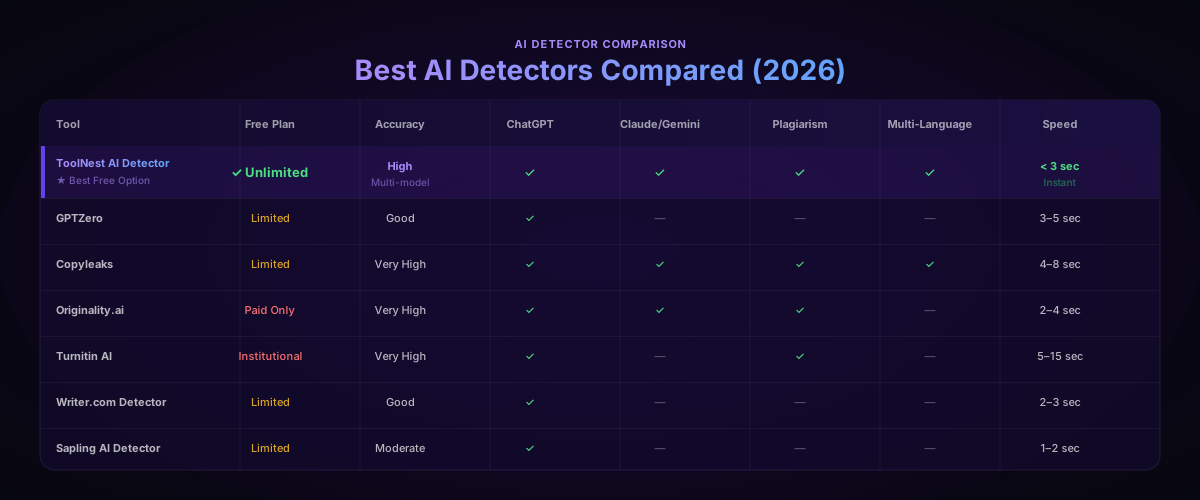
Not all AI detectors are built the same. Here is how the most widely used tools compare on the factors that matter most.
| Tool | Free Plan | Accuracy | ChatGPT | Claude/Gemini | Plagiarism | Multi-Language | Speed |
|---|---|---|---|---|---|---|---|
| ToolNest AI Detector | ✓ Unlimited | High | ✓ | ✓ | ✓ | ✓ | < 3 sec |
| GPTZero | Limited | Good | ✓ | — | — | — | 3–5 sec |
| Copyleaks | Limited | Very High | ✓ | ✓ | ✓ | ✓ | 4–8 sec |
| Originality.ai | Paid Only | Very High | ✓ | ✓ | ✓ | — | 2–4 sec |
| Turnitin AI | Institutional | Very High | ✓ | — | ✓ | — | 5–15 sec |
| Writer.com | Limited | Good | ✓ | — | — | — | 2–3 sec |
| Sapling AI | Limited | Moderate | ✓ | — | — | — | 1–2 sec |
ToolNest AI Detector stands out as the only tool offering unlimited free access with multi-model detection across GPT-4, ChatGPT, Claude, Gemini, Llama, PaLM 2, and Mistral — plus plagiarism checking and support for 50+ languages, all in under three seconds.
Copyleaks and Originality.ai offer very high accuracy and are strong choices for professional publishers and content agencies willing to pay. Turnitin remains the standard for academic institutions but is not accessible to individuals. GPTZero is the most well-known free option but restricts detection to ChatGPT and GPT-4 only on the free tier.
For most individuals, educators, and content teams who need reliable free AI detection without model restrictions, ToolNest AI Detector is the practical first choice.
Detection Accuracy and Limitations
Every AI detector has a real accuracy ceiling. Understanding what affects detection quality helps you interpret results correctly.
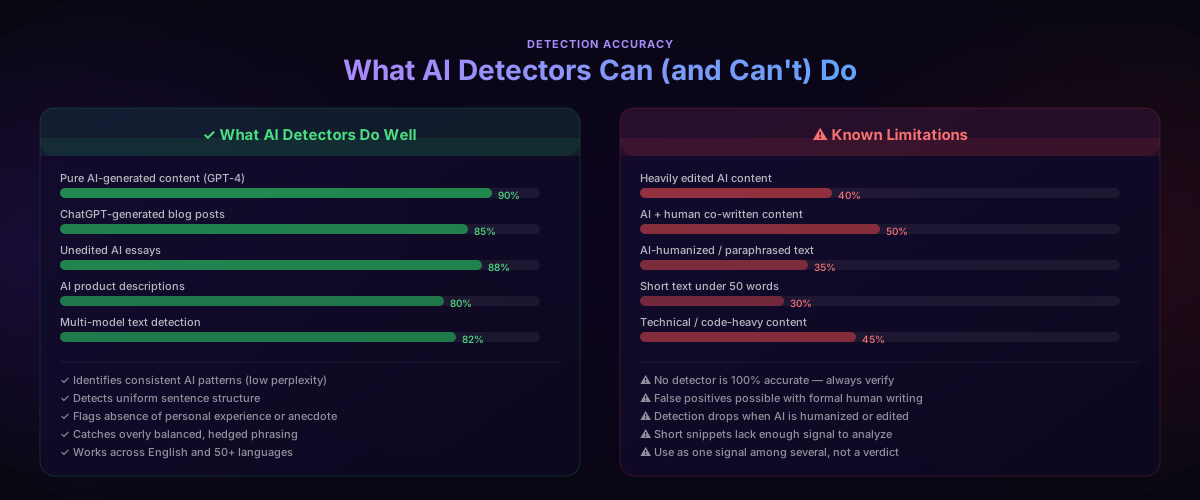
Where detection is most reliable:
- Unedited AI output from GPT-4, ChatGPT, or Claude produces detection accuracy consistently above 85% on well-built tools.
- Longer text provides more signal. A 500-word sample gives the detector far more pattern data than a 50-word snippet.
- Generic AI content — marketing copy, boilerplate emails, standard article formats — is easier to flag because the models produce more uniform output in these contexts.
Where detection becomes less reliable:
- Heavily edited AI content. When a human extensively edits AI output — restructuring paragraphs, changing vocabulary, adding personal anecdotes — the AI signal weakens considerably. Detection rates on heavily edited content can drop to 40% or below.
- AI-humanized text. Tools like the AI Humanizer are specifically designed to reduce AI detection scores by adjusting perplexity and burstiness. Text processed through a humanizer may score below 30% even when originally AI-generated.
- Short text. Anything under 100 words lacks sufficient signal for reliable detection. The statistical patterns that identify AI writing only become meaningful at scale.
- Technical and code-heavy content. Formal technical writing has naturally low perplexity — it follows predictable patterns because precision requires it. AI detectors can falsely flag this as AI-generated.
- Non-native English writing. Some non-native speakers write in ways that superficially resemble AI output — uniform sentence structure, careful word choice, avoidance of idioms. Detectors can produce false positives on this type of writing.
The false positive problem. AI detectors can flag human writing as AI-generated. This is not a bug — it is an inherent limitation of probabilistic analysis. A human who happens to write formally, consistently, and without much stylistic variation may produce text that scores higher than expected. For this reason, never use a detector score as a sole basis for an academic integrity decision or professional judgment.
Use detection as one piece of evidence alongside others: context, the author's history, writing samples for comparison, and direct conversation.
Pros and Cons of AI Detection Tools
Pros:
- Fast and scalable — check thousands of words in seconds
- Identifies patterns invisible to human readers
- Multi-model detection catches content from various AI sources
- Free tools available with no meaningful usage limits
- Useful as a first-pass filter in content review workflows
- Helps educators identify suspected AI submissions for further investigation
- Raises baseline awareness of AI writing patterns
Cons:
- No detector achieves 100% accuracy — false positives and false negatives both occur
- Heavily edited or humanized AI text can evade detection entirely
- Short text samples are unreliable due to insufficient signal
- Detection rates vary significantly by model and content type
- Results should never be used as standalone proof of AI authorship
- Technical and formal writing styles can trigger false positives
The right framing is to treat AI detectors the same way you treat plagiarism checkers: a useful signal that triggers investigation, not a system that produces verdicts.
Who Uses AI Detectors?
Educators and academic institutions use AI detectors to flag suspected AI-written submissions. Detection scores alone are not sufficient evidence for academic penalties — most institutions use them as a trigger for further investigation and conversation.
Content editors and publishers run incoming freelance submissions through AI detectors as part of quality control. With the volume of AI-assisted content rising, editors use detectors to identify text that needs additional review before publication.
SEO and content teams check AI-generated drafts before publishing to assess how much humanization or editing is needed. Search engines have indicated that authenticity and helpfulness matter more than origin — a detector helps teams calibrate how much additional work a piece needs.
HR and recruitment teams sometimes use AI detectors on cover letters and written assessments, though this application is controversial given the false positive rate. When used, it should be one signal among many, not a disqualifying criterion.
Journalists and fact-checkers use AI detection when assessing the authenticity of written sources, press releases, or social media content that may have been AI-generated at scale.
Businesses and legal teams use detectors when reviewing contracts, communications, or documents where knowing the authorship matters for accountability or authenticity.
Common Mistakes When Using AI Detectors
Treating the score as a verdict. A 72% AI score does not prove the text was AI-generated. It means the text has statistical patterns consistent with AI writing. Context, editing, and writing style all affect the score. Use it as a signal, not a conclusion.
Testing text that is too short. Paste at least 150–200 words for a meaningful result. Shorter samples do not give the detector enough pattern data to analyse reliably. A single paragraph can produce wildly variable scores on successive runs.
Ignoring the model selector. Running every text through GPT-4 detection only tells you how likely it is to have come from GPT-4. If the content could have been generated by Claude or Gemini, run it through those models too. Multi-model scanning gives a more complete picture.
Assuming humanized text is safe to publish without review. Passing an AI detector does not mean the content is high quality, accurate, or appropriate. Detection avoidance and content quality are entirely separate concerns. Always review content for factual accuracy and genuine value regardless of detection score.
Using detection to punish without investigation. In educational or professional contexts, a high AI score is a reason to investigate — not a reason to act. The false positive rate means some human-written submissions will score high, and acting on a detector score alone risks penalising someone unfairly.
Not checking the AI Humanizer output. If you are producing AI content and want to reduce detection scores, run your text through the AI Humanizer first, then re-check with the detector to assess the result before publishing.
Frequently Asked Questions
Is the ToolNest AI Detector completely free?
Yes. The AI Detector on ToolNest AI is 100% free with no subscription, no account, and no usage limits. Open the tool, paste your text, and run as many checks as you need.
How accurate is AI detection?
For unedited AI-generated content from major models like GPT-4 and ChatGPT, detection accuracy is consistently high — above 85% on well-built tools. Accuracy drops significantly for heavily edited content, AI-humanized text, and short samples under 100 words. No detector achieves 100% accuracy, and false positives on formal human writing do occur.
Can it detect content from ChatGPT, Claude, and Gemini?
Yes. The ToolNest AI Detector supports multi-model detection across GPT-4, ChatGPT, Claude, Gemini, Llama, PaLM 2, Mistral, and a Custom option. You can select which model to check against, or run multiple checks to get broader coverage.
What does the AI percentage score mean?
The percentage represents the estimated probability that the text was generated by an AI model. A score of 18% means the detector found patterns consistent with AI writing in roughly 18% of the text. Scores below 20% are generally consistent with human writing; scores above 70% are a strong signal of AI generation. The 20–70% range often reflects human-AI collaboration, heavy editing, or stylistic variation.
Can AI detection be fooled?
Yes. Heavily edited AI content, text processed through AI humanizers, and short samples can all reduce detection accuracy significantly. This is why detectors should be used as evidence rather than verdicts. Tools like the AI Humanizer are specifically designed to adjust the statistical patterns that detectors measure.
Will AI detection flag my formal writing as AI-generated?
It is possible. Formal, highly structured writing — academic prose, legal writing, technical documentation — can have naturally low perplexity and uniform sentence structure, which are the same patterns detectors look for in AI text. If you receive a high score on human-written content, context and a writing sample comparison are the appropriate next steps.
Is my text secure when I use the AI Detector?
Yes. Your text is processed securely and is not stored after your session. ToolNest AI does not retain, log, or share your content with third parties.
How is an AI detector different from a plagiarism checker?
A plagiarism checker compares text against a database of existing content to find matches. An AI detector analyses statistical writing patterns to estimate the probability of AI generation — it does not compare against known sources. The two tools address different questions: plagiarism checkers ask "has this been copied?", AI detectors ask "was this written by a machine?". For comprehensive content integrity checking, using both together gives the fullest picture.
Check Your Content — Free, Instant, Accurate
The AI Humanizer, AI Grammar Checker, and AI Text Summarizer are all free on ToolNest AI — but before you publish anything, the AI Detector gives you the confidence to know exactly what you are working with.
Paste your text, select a model, and get a full probability breakdown in under three seconds. No account, no limits, no cost.
AI content is everywhere. Know the difference.
About the author
ToolNest AI Team
The ToolNest AI editorial team covers AI tools, productivity, and the future of online work.
Related Articles
AI Humanizer: Convert AI Text into Natural Human Writing (2026 Guide)
Learn how to humanize AI text instantly with a free AI humanizer. Make ChatGPT, Gemini and Copilot content sound natural, bypass AI detectors, and improve engagement.
AI Grammar Checker: Fix Grammar, Spelling and Writing Instantly (2026 Guide)
Discover how an AI grammar checker can fix grammar mistakes, spelling errors, punctuation issues and improve your writing style instantly — free and accurate.
AI Chat: The Complete Guide to AI Chatbots in 2026
Everything you need to know about AI chat in 2026. Compare ChatGPT, Claude and Gemini, learn how to get better responses, and try all top models free with ToolNest AI Chat.