Text Statistics: Readability Scores & Keyword Density Explained + Free Tool
Learn how the Flesch Reading Ease and Flesch-Kincaid Grade Level formulas work, what keyword density means for SEO, and why syllable counting is inherently approximate. Free, instant text analysis.
Founder & Developer, ToolNest AI
Published
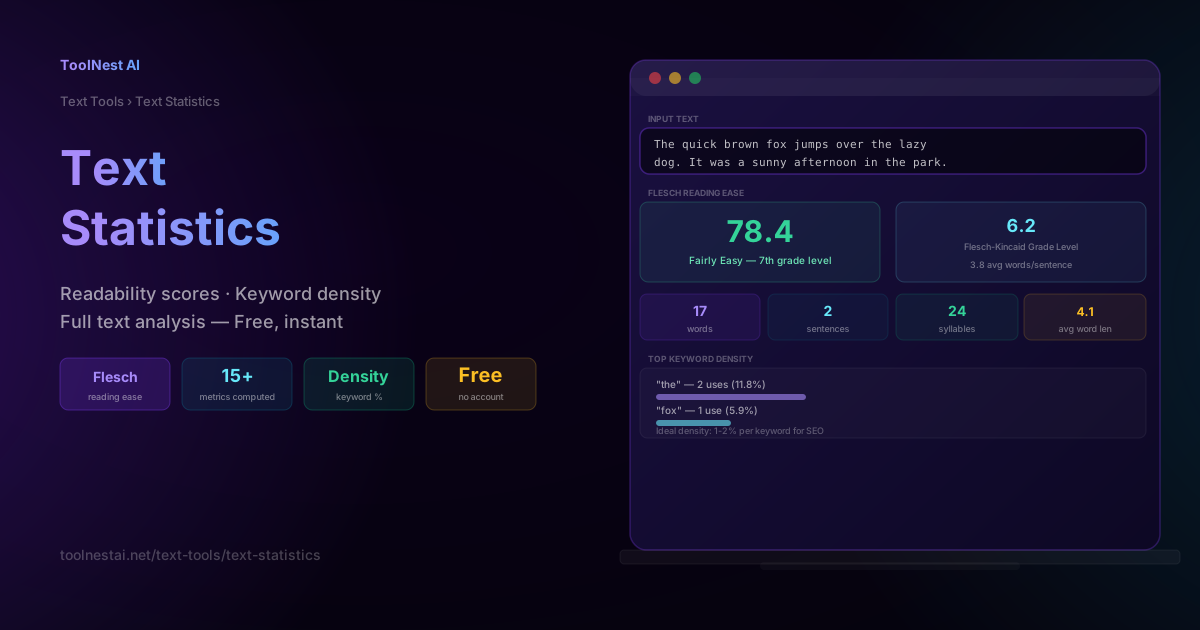
"Write at an 8th-grade reading level" is advice you've probably heard, but rarely explained — where does that number come from, and how is it actually calculated? This guide breaks down the Flesch Reading Ease and Flesch-Kincaid Grade Level formulas that power nearly every readability checker, explains keyword density for SEO, and covers why counting syllables in English is trickier than it sounds.
Get a full text analysis instantly with the ToolNest AI Text Statistics tool.
Flesch Reading Ease
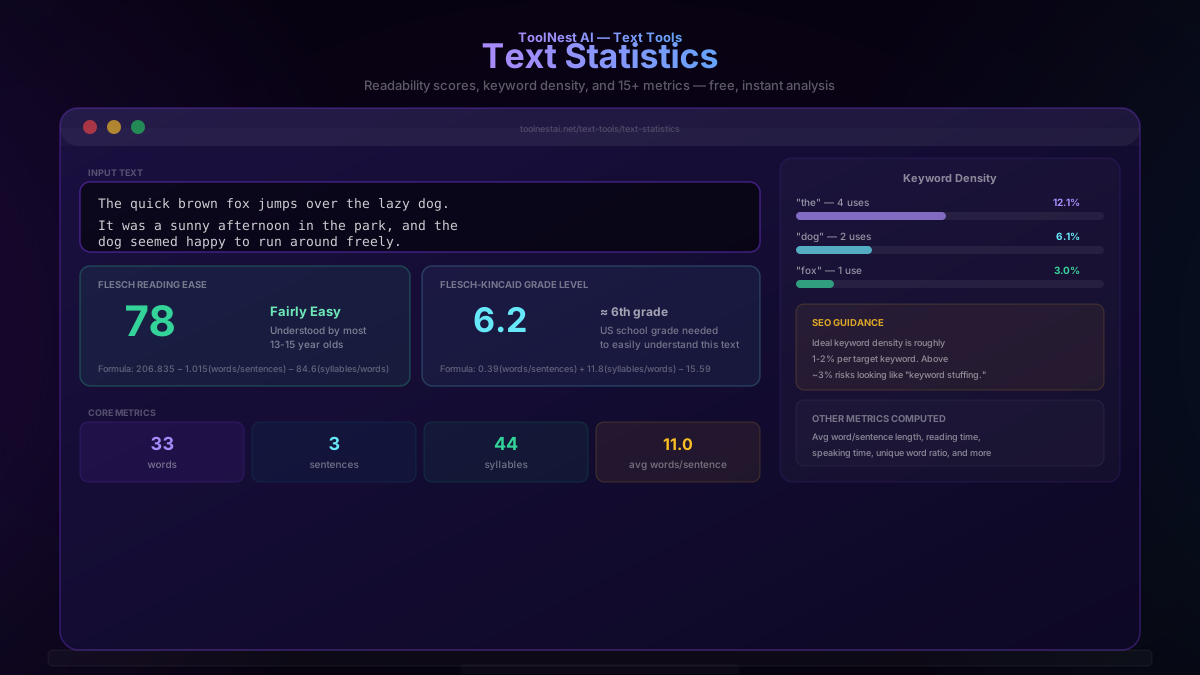
Developed by Rudolf Flesch in 1948, the Flesch Reading Ease formula remains the most widely used readability metric today — built into Microsoft Word, Google Docs add-ons, and virtually every SEO writing tool.
206.835 − 1.015 × (words ÷ sentences) − 84.6 × (syllables ÷ words)
The formula produces a score from roughly 0 to 100. Higher scores mean easier reading. It penalizes two things: longer sentences (more words per sentence) and longer words (more syllables per word) — both of which correlate strongly with how hard text is to parse.
The Reading Ease Scale
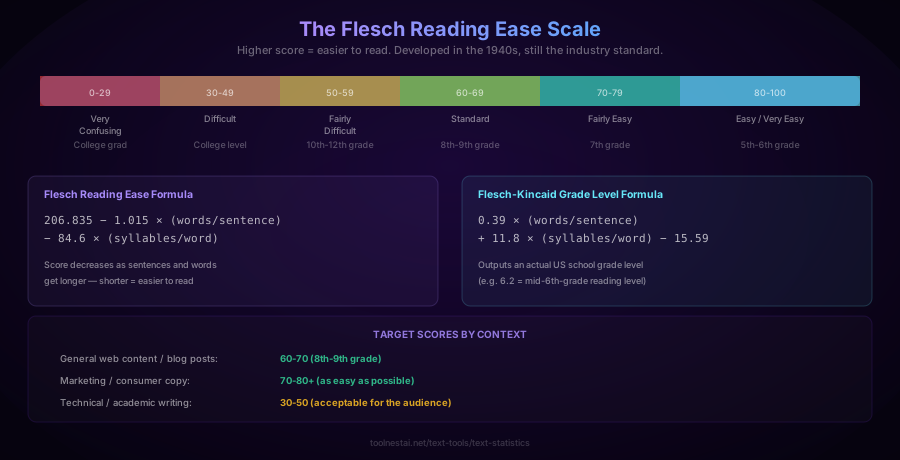
| Score | Description | Approximate reading level |
|---|---|---|
| 90-100 | Very Easy | 5th grade |
| 80-89 | Easy | 6th grade |
| 70-79 | Fairly Easy | 7th grade |
| 60-69 | Standard | 8th-9th grade |
| 50-59 | Fairly Difficult | 10th-12th grade |
| 30-49 | Difficult | College level |
| 0-29 | Very Confusing | College graduate |
Target scores by context:
- General web content / blog posts: aim for 60-70 (8th-9th grade), the widely cited sweet spot for broad readability without feeling condescending
- Marketing / consumer copy: aim as high as 70-80+, since easier text converts better and reaches a wider audience
- Technical or academic writing: a lower score (30-50) may be entirely appropriate given the specialized audience and unavoidable technical vocabulary
Flesch-Kincaid Grade Level
A companion formula, Flesch-Kincaid Grade Level, uses the same underlying inputs (average sentence length and syllables per word) but outputs a direct US school grade level instead of an abstract 0-100 score:
0.39 × (words ÷ sentences) + 11.8 × (syllables ÷ words) − 15.59
A result of 6.2 means the text is written at roughly a mid-6th-grade reading level — the U.S. Department of Defense actually mandates Flesch-Kincaid grade level targets for the readability of military technical manuals, which is part of why this specific formula remains in wide official use today.
Keyword Density for SEO
Keyword density measures how frequently a specific word or phrase appears relative to the total word count of a piece of content:
Keyword Density = (keyword occurrences ÷ total words) × 100
The generally cited ideal range is roughly 1-2% per target keyword. Content that repeats a keyword excessively — commonly cited as anything above roughly 3% — risks resembling "keyword stuffing," an outdated SEO tactic from the early 2000s that modern search engines now actively penalize rather than reward. Contemporary SEO best practice favors natural language and semantic variation (using related terms and synonyms) over rigid exact-match keyword repetition.
Keyword density is a useful sanity check — flagging accidental over-repetition of a term — but it should never be treated as a target to hit mechanically; writing naturally for your actual audience produces better results than optimizing for a density percentage.
Why Syllable Counting Is Approximate
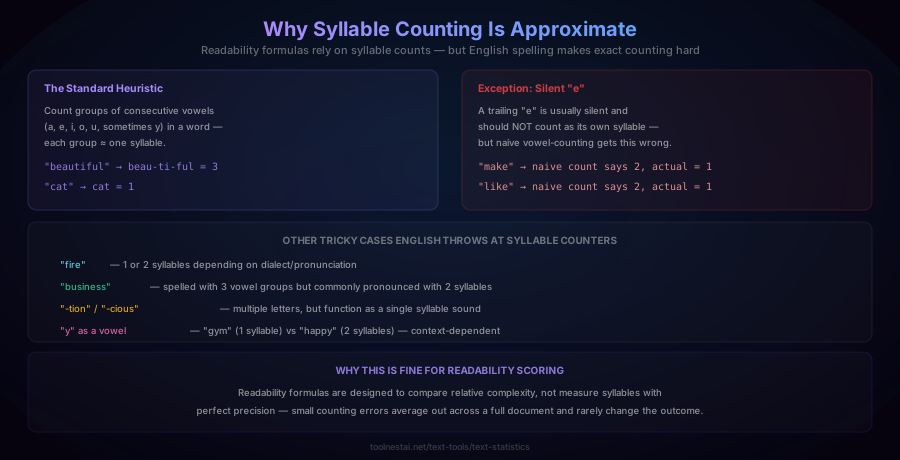
Readability formulas depend on counting syllables per word, and English spelling makes this surprisingly imprecise to automate.
The standard heuristic: count groups of consecutive vowels (a, e, i, o, u, and sometimes y) in a word — each group approximates one syllable. "beautiful" splits into beau-ti-ful for 3 syllables; "cat" has one vowel group for 1 syllable.
The main exception — silent "e": A trailing "e" is usually silent in English and should not count as its own syllable, but naive vowel-group counting gets this wrong. "make" has two vowel groups (a, e) but only one actual syllable; the same is true for "like", "time", and countless other common words.
Other genuinely tricky cases:
"fire"can be pronounced as one or two syllables depending on dialect and regional accent"business"is spelled with three vowel groups but is commonly pronounced with only two syllables- Letter combinations like
-tionand-ciousinvolve multiple letters but function phonetically as a single syllable sound - The letter
"y"sometimes acts as a vowel ("gym"— one syllable) and sometimes as a consonant within a syllable ("happy"— two syllables)
Why this is fine in practice: readability formulas are designed to compare relative text complexity, not to measure syllables with linguistic precision. Small counting errors on individual words average out across a full paragraph or document and rarely change the overall readability category — the formulas were built and validated with this approximation in mind from the start.
Other Metrics Computed
Beyond readability and keyword density, a full text analysis typically includes:
- Reading time — estimated based on an average adult reading speed of roughly 238 words per minute
- Speaking time — estimated based on an average speaking pace of roughly 130-150 words per minute, useful for scripting presentations or videos
- Unique word ratio — the number of distinct words divided by total word count, a rough proxy for vocabulary diversity (a low ratio may indicate repetitive writing)
- Average word length — average character count per word, another factor correlated with text complexity
- Average sentence length — average word count per sentence, one of the two core readability inputs
How to Use the Text Statistics Tool
The ToolNest AI Text Statistics tool analyzes your text entirely in your browser.
- Paste your text into the input field
- View readability scores — Flesch Reading Ease and Flesch-Kincaid Grade Level, with a plain-language interpretation of what the number means
- Check keyword density — see your most frequently used words and their density percentage, helping identify unintentional over-repetition
- Review core metrics — word count, sentence count, syllable count, reading time, and more, all computed simultaneously
Readability Formulas in Different Languages
JavaScript (simplified syllable counting and Flesch score):
function countSyllables(word) {
  word = word.toLowerCase().replace(/e$/, ''); // strip trailing silent e
  const matches = word.match(/[aeiouy]+/g);
  return matches ? matches.length : 1;
}

function fleschReadingEase(text) {
  const sentences = text.split(/[.!?]+/).filter(Boolean).length;
  const words = text.split(/\s+/).filter(Boolean);
  const syllables = words.reduce((sum, w) => sum + countSyllables(w), 0);
  return 206.835 - 1.015 * (words.length / sentences) - 84.6 * (syllables / words.length);
}
Python (using the textstat library):
import textstat

textstat.flesch_reading_ease(text)
textstat.flesch_kincaid_grade(text)
textstat.syllable_count(text)
Common Mistakes
Mistake 1: Chasing an arbitrarily low grade level for content that needs technical precision. A legal document, medical paper, or highly technical guide may legitimately require complex sentence structure and specialized vocabulary. Readability targets should match your actual audience's needs, not a universal "lower is always better" rule.
Mistake 2: Stuffing keywords past a healthy density to try to game search rankings. Modern search engines have moved well beyond simple keyword frequency counting and now penalize unnatural repetition. Write for readers first; density is a diagnostic check, not an optimization target.
Mistake 3: Treating readability scores as an absolute measure of writing quality. A high Flesch Reading Ease score means the text is structurally easy to parse — it says nothing about whether the content is accurate, engaging, well-organized, or persuasive. Readability is one input among many for good writing, not a complete quality metric on its own.
Mistake 4: Comparing readability scores across languages. These formulas were calibrated specifically for English and its syllable and word-length patterns. Applying the same formula (and grade-level interpretation) to text in another language produces meaningless or misleading results without language-specific recalibration.
Frequently Asked Questions
What is a good Flesch Reading Ease score?
For general web content and blog posts, a score of 60-70 is widely considered the target — equivalent to an 8th-9th grade reading level, understandable by the vast majority of adult readers without feeling oversimplified. Marketing and consumer-facing copy often benefits from scores of 70 or higher for maximum accessibility. Technical or academic writing may reasonably score lower (30-50) given its specialized audience and vocabulary.
How is the Flesch-Kincaid Grade Level different from Flesch Reading Ease?
Both formulas use the same two inputs — average sentence length and average syllables per word — but express the result differently. Flesch Reading Ease produces a 0-100 score where higher means easier to read. Flesch-Kincaid Grade Level produces a direct US school grade level number (e.g., 6.2 means approximately mid-6th-grade reading level), which some readers find more intuitive than an abstract 0-100 scale.
What is keyword density and why does it matter?
Keyword density is the percentage of a text's total words that are a specific target keyword, calculated as (keyword occurrences ÷ total words) × 100. It matters for SEO as a sanity check against over-optimization — content with a keyword density much above roughly 3% risks looking like "keyword stuffing," an outdated tactic search engines now penalize. The generally recommended range is around 1-2% per target keyword, though modern SEO prioritizes natural writing over hitting a specific percentage.
Why is syllable counting only approximate?
English spelling doesn't map cleanly to pronunciation. Standard syllable-counting heuristics count groups of consecutive vowels, but this misses cases like silent trailing "e" (which shouldn't count as a syllable but adds a vowel group), dialect-dependent pronunciation differences (like "fire" being one or two syllables depending on accent), and letters like "y" that sometimes function as vowels and sometimes as consonants. These small inaccuracies average out across a full document and rarely change the overall readability category.
Can readability formulas be used for languages other than English?
Not directly. The Flesch Reading Ease and Flesch-Kincaid formulas were specifically calibrated using English text and English syllable/word-length patterns. Other languages have different syllable structures and word-length distributions, so applying the same formula and grade-level interpretation to non-English text produces inaccurate or meaningless results. Language-specific readability formulas exist for many other languages but use different coefficients.
Does a lower readability score mean worse writing?
No — readability scores measure structural complexity (sentence and word length), not writing quality, accuracy, or engagement. A lower score simply means the text requires a higher reading level to parse easily, which may be entirely appropriate for the intended audience (e.g., academic papers, legal documents, or highly technical content). Readability is one useful signal among many, not a complete measure of good writing.
How is reading time calculated?
Reading time estimates are typically based on an average adult silent reading speed of around 200-250 words per minute (238 wpm is a commonly cited figure from reading speed research), dividing the total word count by this rate to estimate minutes. Speaking or presentation time uses a slower rate, typically 130-150 words per minute, reflecting the natural pace of spoken delivery.
What counts as a "unique word" in the unique word ratio?
A unique word ratio counts each distinct word form once, regardless of how many times it repeats in the text, then divides that count by the total word count (including repeats). For example, in "the cat sat on the mat," there are 6 total words but 5 unique words ("the" repeats), giving a unique word ratio of about 83%. A lower ratio can indicate more repetitive vocabulary, though some repetition is natural and often stylistically appropriate.
About the author
Emir LočićI'm a developer focused on building practical online tools, with several years of experience in web development. I created ToolNest AI to make useful AI-powered tools simple, accessible, and free to use in one place.
Related Articles
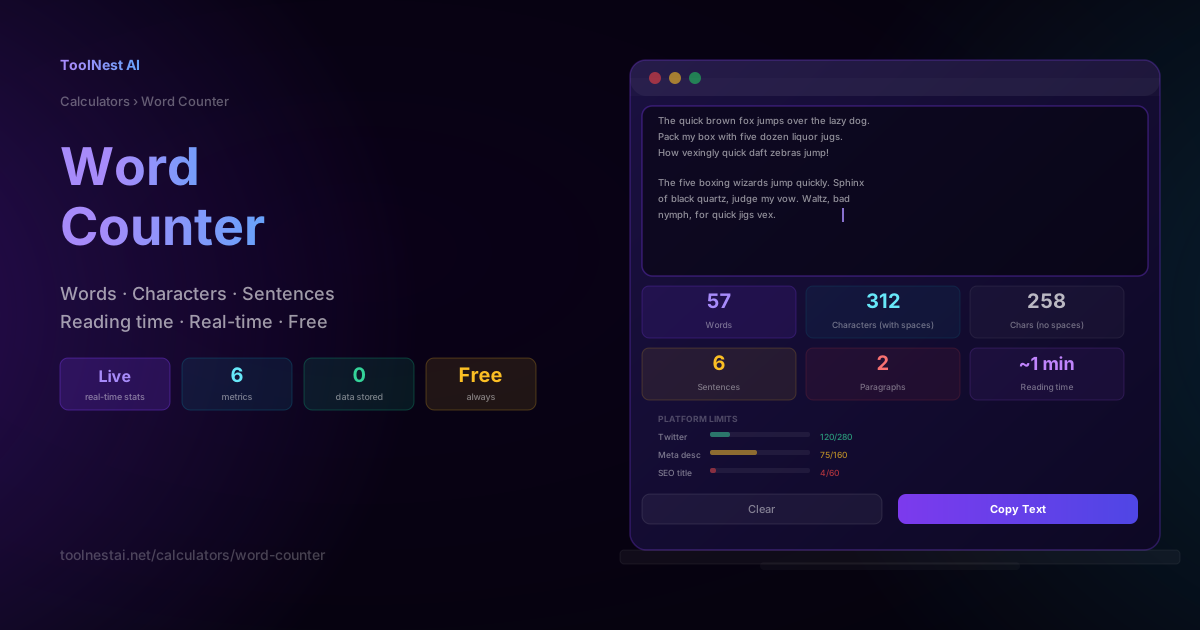
Word Counter: Count Words, Characters & Reading Time Free
Learn how to use a word counter to track words, characters, sentences, paragraphs and reading time — plus a complete reference of character limits for every major platform.
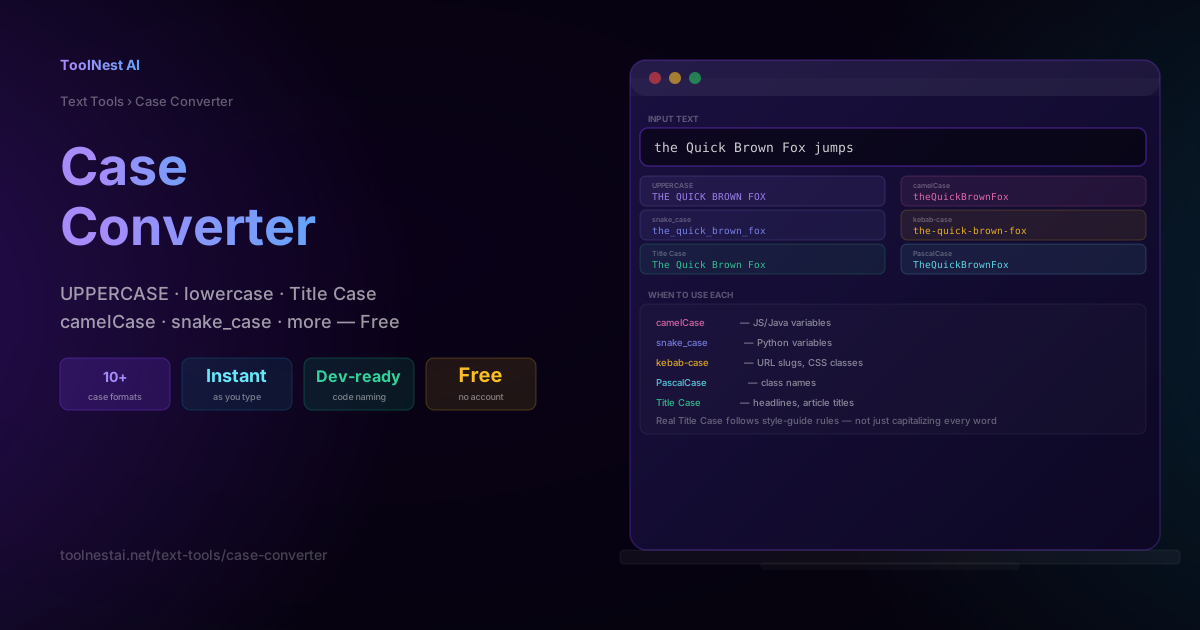
Case Converter: UPPERCASE, camelCase, snake_case & More — Free Tool
Learn every text case format — UPPERCASE, Title Case, camelCase, snake_case, kebab-case, and more — when to use each for writing and code, and the real rules behind proper Title Case. Free, instant tool.